
Aug.24, 2026
How do I Coordinate Marketplace Premiums, Expected Income, and the Self-Employed Health Insurance Deduction?
 By E. Ryan Mink
Key Points:
- Marketplace premium tax credits and self-employed health insurance deduction are interconnected.
- Income estimated matter because final eligibility is determined at tax filing.
- Year-round planning can help avoid tax surprises.
Marketplace health insurance can provide meaningful tax benefits, but it can also create surprises when income changes during the year. This is especially true for self-employed individuals because the Premium Tax Credit (PTC) and the self-employed health insurance deduction are connected. One can affect the other, and both may affect the final tax result.
How are Marketplace premiums determined?
When you apply for Marketplace coverage, you generally estimate your household income, household size, and other coverage information for the upcoming year. That estimate helps determine whether you may qualify for advance payments of the Premium Tax Credit, which can lower monthly premiums. The final amount is not determined until your income tax return is prepared using actual year-end information.
What is the Premium Tax Credit?
The Premium Tax Credit, often called the PTC, is a refundable tax credit that helps eligible individuals and families pay for health insurance purchased through the Marketplace. The credit may be paid in advance to the insurance company during the year, but it must be reconciled on the federal income tax return, generally using Form 8962.
If advance credit payments are higher than the final allowable credit, the excess may have to be repaid with the tax return. For tax years beginning after December 31, 2025, IRS guidance indicates the prior repayment limitation caps no longer apply, making accurate income estimates and timely Marketplace updates more important.
The PTC rules are found under IRC Sec. 36B and related regulations. In general, eligibility depends on Marketplace enrollment, household income, filing status, family size, and whether the taxpayer or family member is eligible for other minimum essential coverage, such as affordable employer coverage or certain government coverage.
What is the 100%–400% federal poverty level rule?
The PTC is generally limited to taxpayers with household income of at least 100% and not more than 400% of the applicable federal poverty level (FPL). Temporary expanded eligibility allowed some households above 400% of FPL to qualify through 2025. Unless the law changes, for 2026 and later, taxpayers above 400% of the applicable FPL generally will not qualify for the federal PTC.
This creates a practical planning issue. A self-employed taxpayer whose income is close to the 400% FPL threshold may lose the entire PTC if final household income is even slightly too high. Income changes, retirement contributions, business deductions, and health insurance deductions may all affect that calculation.
What is the self-employed health insurance deduction?
The self-employed health insurance deduction allows certain self-employed taxpayers to deduct eligible health insurance premiums as an above-the-line deduction. This means it may reduce adjusted gross income, or AGI, even if the taxpayer does not itemize deductions. The deduction is governed by IRC Sec. 162(l).
The deduction may be available to a sole proprietor, partner, or more-than-2% shareholder of an S corporation, but it is subject to important limitations. The plan must generally be connected to the self-employed trade or business, and the deduction generally cannot exceed earned income from that business.
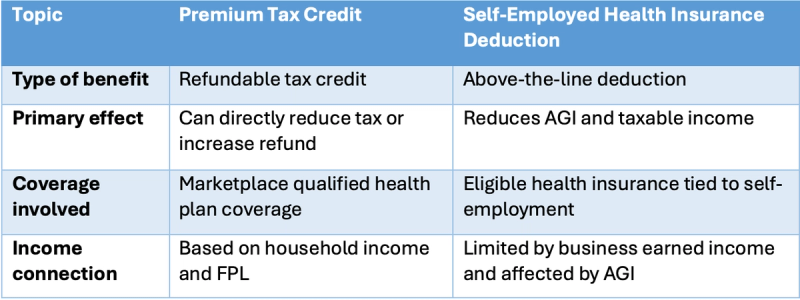
How is the self-employed health insurance deduction different from the Premium Tax Credit?
How do the PTC and the deduction affect each other?
For self-employed taxpayers with Marketplace coverage, the two benefits can create a circular calculation. The self-employed health insurance deduction reduces AGI, which can affect household income for PTC purposes. At the same time, the PTC reduces the amount of premiums that may be deductible because a taxpayer generally cannot receive both a credit and a deduction for the same premium dollars.
IRS Publication 974 recognizes this interaction and provides optional calculation methods, including an iterative calculation method and a simplified calculation method. This is one reason tax software results, income projections, and year-end tax planning should be reviewed carefully when a self-employed taxpayer receives advance PTC payments.
Why does year-round planning matter?
Marketplace assistance is based on estimates during the year but reconciled using actual income on the tax return. Self-employed income can fluctuate significantly because of business profits, large projects, investment income, retirement distributions, or changes in household size. A change in income may affect the PTC, the health insurance deduction, or both.
Planning may also include reviewing retirement contribution options, such as SEP or other self-employed retirement plan contributions, because they may reduce AGI and allow for a larger PTC. These strategies are subject to plan rules, deadlines, and contribution limits, so they should be reviewed before year-end whenever possible.
What should taxpayers do?
If you purchase Marketplace insurance and are self-employed, it is important to monitor income throughout the year, report significant changes to the Marketplace, and discuss planning opportunities with your firm representative. Coordinating income projections, retirement contributions, the PTC, and the self-employed health insurance deduction before year-end may help reduce surprises when your tax return is filed.
Suttle & Stalnaker, PLLC is ready to help you. If you would like more information on how this applies to you, please contact our office at 304.343.4126 or Ryan Mink, CPA at rmink@suttlecpas.com.
*Our articles are generally prepared internally, but could contain AI assistance. All articles are reviewed by Suttle & Stalnaker, PLLC professionals for accuracy and completeness and reflect the knowledge of our team.